
Findings of misconduct against five Toronto officers arising out of Project Olive Branch Podcast

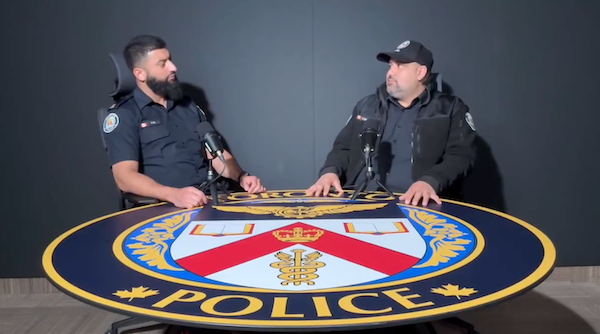
Readers will recall community outrage over a Toronto Police Service podcast released in March 2025. The podcast featured two TPS Muslim Liaison Officers, Constables Farhan Ali and Harron Siddiqui in conversation about the events of October 7, 2023 and following, and their impact on the increase in “reverts” to Islam. Complaints to the Law Enforcement Complaints Agency (LECA), one of Ontario’s police oversight agencies resulted in an investigation by York Regional Police Service (YRPS). YRPS’s report found five officers to have engaged in misconduct in violation of the applicable Code of Conduct for Police Officers under a regulation to the Community Safety and Policing Act, 2019. Subsection 10(1) states, “A police officer shall not conduct themselves in a manner that undermines, or is likely to undermine, public trust in policing.”
The misconduct related to the second episode of a podcast that formed part of Project Olive Branch, a concept created by Officers Ali and Siddiqui, both members of TPS’s Community Partnership and Engagement Unit (CPEU) in response to the significant increase in demonstrations related to the ongoing conflict in the Middle East since October 7, 2023. There were concerns expressed in the Muslim community regarding trust in the police and impartial policing.
The four desired outcomes for Project Olive Branch were:
i. Youth Engagement – Build strong connections with Muslim Youth;
ii. Increase connections with Muslim Community – Connect TPS directly with faith leaders and with places of worship;
iii. Increase Hate Crime Prevention and Awareness – Education was a key component to be proactive in addressing hate-motivated incidents/crimes; and
iv. Increase Attendance at Community Events – Celebrate cultural and religious heritage events with communities to improve trust and foster relationships.
The project was approved by the Chief’s Office, with a reporting relationship to take place with that office. The Toronto Police Services Board also supported the project.
The podcast was part of the fourth desired outcome and supposed to be a light-hearted, guest driven, and community focused event involving Officers Ali and Siddiqui. The controversial second episode was released on March 10, 2025, having been reviewed and approved by CPEU supervisors before its release.
The episode consisted of an unscripted conversation between the two officers, in uniform, filmed with TPS branding. The conversation included comments suggesting that many people began learning about Islam after October 7, leading to “reverts” (the belief that all persons are born connected to the faith of Islam and may later reconnect after having drifted away from it). The following is a portion of the podcast that was the subject of the complaint:
…It, it's funny you you say this because, um, you know, through social media, a lot of people after October 7th started learning about Islam. And, and they said, okay, what is it with the religion that everyone, why is it so hated? Yeah. You know what I mean? Why are, why are they being attacked all the time? So people say, you know what, let me learn about Islam. And there have been a lot of reverts. Um, through this whole process. I, I would, I couldn't imagine, like, I, I guess, I guess when you're on social media, most of the feeds come through you. Once you see one, it just keeps You coming. But the amount of people that are, that are reverting to Islam is unbelievable. And, and they're just, um, I guess through education, right? They're actually educating themselves and saying, what is it that Muslims are being, um, targeted? And why are they being targeted? Let me learn about this religion. What are these, what are these accusations that they're saying about Islam? And let me learn about it myself and figure out, hey, is is it actually true or not?...
Other comments cautioned against labeling all pro-Palestinian protests as “Hamas rallies.” The episode quickly went viral, generating significant negative criticism, including but not limited to many Jewish community members. Many interpreted the remarks as politically charged, insensitive, and minimizing the trauma of October 7. Media monitoring by the police showed 96.8% negative sentiment to the podcast which attracted international attention.
The superintendent of the CPEU was interviewed as part of YRPS’s investigation. He was unavailable to review the episode prior to its release and instead delegated the task to Acting Staff Sgt. Rich Sidhu who asked Staff Sgts. Michael DeZilva and Maggie Mastrokostas, CPEU senior managers, to assist him. The superintendent received no follow-up from them respecting this episode before its release.
It is significant, however, that the superintendent had been involved in an earlier review of Constable Ali’s corporate social media activity unrelated to the podcast. That review had recommended that Constable Ali’s social media content focus more specifically on policing subject-matter and less on personal matters. The superintendent had discussed the recommendation with Constable Ali, who acknowledged that his “personal content could be perceived as triggering by some individuals in the current social climate.”
The three supervisors referred to above reviewed Episode Two before its release. None had completed TPS social media training, which specifically warns against political commentary, sensitive or divisive topics, and personal opinions that may compromise neutrality. They noticed the religious content (e.g., the term “revert”) but did not flag the broader problems with the episode and approved the episode without edits. In hindsight, the supervisors acknowledged a lack of cultural awareness and failure to anticipate public reaction. All of the supervisors indicated that they believed the reference to October 7 was used only as a “temporal point of reference” and that it was not intended to antagonize or offend anyone.
Both Officers Ali and Siddiqui declined to make themselves available for a compelled interview by the YRPS investigator. They also failed to produce any notes relating to the podcast or Project Olive Branch in general. Officers assigned to the CPEU (like other officers) are expected to document daily activities through handwritten entries maintained in police-issued memorandum books. Given the lack of notes and interviews, the investigator was unable to assess the intentions or perspectives of either officer regarding Episode Two.
The YRPS report concluded that although the podcast comments reflected the officers’ personal views, they were in uniform and using official TPS channels. As such, their comments were reasonably interpreted as representing TPS views. The report stated that there was no evidence to suggest that either officer intended to offend members of the public or damage public confidence in policing, but that “by engaging publicly on highly polarizing and politically sensitive topics, the officers failed to appreciate how their comments could alienate segments of the community and diminish confidence in their ability to remain fair and unbiased.”
The report also found that, based on the extensive public reporting of ongoing tensions between affected communities as well as their policing experience in Toronto during a period of “heightened demonstrations and community sensitivity,” Officers Ali and Siddiqui ought to have been aware of the potential impact of their comments. The decision to make such statements while in police uniform and in a publicly released format contributed to a perception that TPS was not maintaining strict neutrality on a highly sensitive issue, thereby undermining public confidence in policing. The prior supervisory guidance provided to Constable Ali to avoid personal/political content made his lapse more egregious.
As far as the supervising officers were concerned, their review failed to identify or address the risks associated with the content prior to its release. As approving authorities, they were responsible for the content, which contributed to perceptions that may have undermined public trust and confidence in TPS. Accordingly, the allegation of misconduct against all five officers was substantiated.
This podcast and the report that followed raise several important issues for me.
First, Officers Ali and Siddiqui chose not to cooperate with the investigation into their actions, and they produced no notes of their daily activities. As well, the podcast raises questions for me that extend beyond the mere exercise of poor judgment in addressing politically sensitive issues. Those questions remained unanswered because of their failure to cooperate and the lack of contemporaneous notes. It also raises concerns about their suitability as community liaison officers.
The role of a community liaison officer, a critically important role in policing, includes promoting dialogue and understanding between the police and the community. Officers entrusted with this role have a duty not only to build trust between their assigned community and the police, but also to support respectful dialogue across communities. I am unconvinced that the expressed attitudes of the officers (apart from the inadvisability of the subject matter altogether) show real insight into the nature and depth of the issues at play and how they should contribute to respectful dialogue, rather than deepening division and acrimony.
Second, although the finding of misconduct against the five officers was appropriate, the report revealed larger systemic issues. The superintendent delegated responsibility for reviewing the podcast to others who had no social media training or awareness of the issues of importance. This was particularly problematic given the superintendent’s knowledge of prior social media concerns. The report also stated that the Chief’s Office maintained a reporting role with respect to Project Olive Branch, but it does not explain what oversight, if any, the Chief’s Office exercised as the episodes were approved and released to the public.
Third, both Officers Ali and Siddiqui had completed social media training, which expressly directed officers not to engage in political commentary, raise sensitive or divisive topics, or express personal opinions that may compromise neutrality. Their conduct therefore raises a serious question about the effectiveness of the training, including whether it was sufficiently understood, reinforced, or applied in practice.
Fourth, the report’s analysis itself contains two troubling passages concerning the characterization of October 7, 2023. Paragraphs 98 and 99 are reproduced below, with emphasis added:
It must be acknowledged that there are diverse perspectives concerning the events of October 7, 2023, and the demonstrations that followed. Individuals may view those events through different historical, political, cultural, or personal lenses. Consequently, discussions relating to the conflict can be deeply personal and emotionally charged.
The events of October 7, 2023, and the subsequent conflict have generated significant public debate and differing viewpoints both locally and internationally. Given the sensitivity of the subject matter and the potential for differing interpretations, any public discussion concerning these events required care, professionalism, and consideration of diverse audiences.
There is no doubt that the ongoing conflict in the Middle East, and the demonstrations that followed October 7, 2023, are viewed through different historical, political, cultural, and personal perspectives. But there is no legitimate controversy about the nature of the events of October 7, 2023. By referring to “diverse perspectives” and “differing viewpoints” concerning the events, including October 7, 2023, the report can be seen as catering to a perspective that should have no place in discourse – a tolerance for the terrorist attacks that took place on October 7 and their characterization as susceptible to diverse legitimate views.
This case should serve as an important wake-up call for police services across the country: effective hate crime prevention and awareness begins within communities, and community liaison officers play a crucial role in advancing that work with care, neutrality, and accountability.
-30-
About the Author
Rochelle Direnfeld is ALCCA’s Senior Criminal Counsel. She was called to the Ontario bar in 1990 and has served in the Ontario Public Service for over 32 years as an assistant crown attorney, deputy crown attorney, crown counsel, and finally as Deputy Director for Toronto Crown Attorneys in the Criminal Law Division of the Ministry of the Attorney General. Rochelle retired from public service at the end of 2023. During her career, she prosecuted a wide variety of Criminal Code cases in the Ontario Court of Justice, Superior Court of Justice, and the Ontario Court of Appeal.
Rochelle is also the Chair of the Canadian Criminal Law Working Group, a national initiative bringing together leading criminal lawyers to strengthen the legal response to antisemitic hate crimes and support victims across Canada.
She has also been selected to join the Toronto Police Service Board’s Jewish Community Advisory Table, an initiative aimed at strengthening dialogue and collaboration between the Jewish community and the Toronto Police Service on issues of community safety and policing.