
When Withdrawing Charges Represents Justice Denied


Existing law and policies permit prosecutors to exercise their discretion to withdraw criminal offences, particularly non-violent, minor offences, when it is in the public interest to do so. Typically, the accused must participate in some sort of measure such as counselling, restitution to the victim, mediation, a letter of apology, or community service. As the following examples make apparent, this exercise of discretion, when inappropriately exercised, can have significant harmful effects on the Jewish community and public order more generally.
In April 2025, Mai Abdulhadi, 41, was arrested and charged with three counts of uttering threats to cause death or bodily harm. The charges related to her conduct on November 21, 2024, where she was filmed outside Concordia University’s downtown campus making Nazi-style salutes and threatening three Jewish students with “the final solution.” The video of Abdulhadi marching about, pulling her keffiyeh off at times to expose her face, and asking students if they knew that “the final solution is coming”, while making a Nazi-style salute, quickly went viral. Shortly thereafter, it was discovered that Abdulhadi was the owner of two Second Cup franchises at the Jewish General Hospital in Montreal. Within days, the franchise’s parent company terminated its contract with her.
On March 25, 2026, the charges were withdrawn against her in a Quebec courtroom. It was revealed that Abdulhadi had completed a “Programme de mesures de rechange pour adultes (PMRG)” or Adult Alternative Measures Program, authorized under section 717 of the Criminal Code. Other provinces may utilize the terms “diversion” or “Direct Accountability” for these programs. It is not clear what sort of measure(s) Abdulhadi was required to complete.
Regardless, this exercise of prosecutorial discretion was, on its face, deeply problematic. The accused’s conduct, particularly her references to the coming final solution invited charges of advocating genocide, wilful promotion of hatred against Jews, and/or public incitement of hatred. The threatening death or bodily harm charges were themselves serious and grounded in violence. Absent truly exceptional circumstances, the withdrawal of these charges and the failure to lay even more serious charges can reasonably be regarded as normalizing Jew-hatred and extremism. The pervasive antisemitism that is now being experienced by our community should have informed the public interest in the exercise of prosecutorial discretion in this case.
Another stark example of justice denied occurred when charges were withdrawn against a well-known antizionist activist, Tarek Loubani, who vandalized a London MP’s office with ketchup, ostensibly to protest the federal government’s support of Israel. When the original charge of mischief was withdrawn by the prosecution, Loubani immediately repeated the offence. Unfathomably, the prosecution withdrew the second charge of mischief, purportedly in the public interest. The accused appeared to be thumbing his nose at the law with impunity.
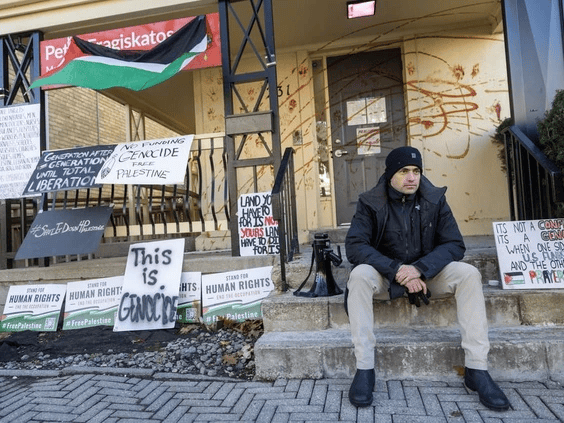
On the spectrum of criminal charges, defacing a politician’s office might not be regarded as particularly serious. However, the cumulative effect of withdrawals of mischief charges in this case and in others where the accused justify their actions on “political” grounds undermine our most basic democratic values. As the sentencing judge in another case stated:
… [w]hen disrespect for the rule of law is condoned, democracy is jeopardized. Democratic ideals, including the right of every person to live secure in the knowledge that their dignity and personhood is protected in Canada is jeopardized whenever the ends-justifies-the-means reasoning takes precedence over the rule of law.
The inevitable messaging here is that the administration of justice tolerates antizionist criminality, further normalizing the demonizing of anyone who supports Israel’s right to exist or who disputes any anti-Israel or antizionist narratives.
It should be of little surprise when more serious crimes are committed that target the Jewish community. We know from our interactions with police that they too are frustrated at the disconnect, in a number of instances, between their position that charges should be laid and the prosecutorial response.
Ontario MPP Michelle Cooper’s Dedicated Hate Crimes Unit
It is for these reasons, among others, that ALCCA’s leadership supported Ontario MPP Michelle Cooper’s private member’s motion calling for a dedicated hate crime prosecution unit in Ontario, a step towards greater consistency, stronger expertise, and informed decision-making in cases involving bias, prejudice or hate. The motion passed unanimously on April 16, 2026.
ALCCA has repeatedly called for cases involving allegations of bias, prejudice or hate to be dealt with exclusively by prosecutors with specialized training in hate crimes as well as in contemporary antisemitism and other forms of hate. The Attorney General’s existing Hate Crime Working Group does not prosecute many of these cases nor does it direct how prosecutorial discretion will be exercised.
In the last 12 months, we have seen instances where:
Prosecutors “diverted” cases without understanding why the evidence supported a finding that conduct was motivated by bias, prejudice or hatred against Jews;
Prosecutors “diverted” such cases ostensibly in the public interest when the evidence of guilt was overwhelming, and the accused were unrepentant;
Prosecutors failed to “red flag” cases that involved allegations of bias, prejudice or hate against Jews, despite the obligation to do so to ensure they are dealt with appropriately;
Prosecutors sought inadequate conditions at bail hearings when accused were to be released from custody in cases involving allegations of bias, prejudice or hate motivation;
Prosecutors (and police) failed to even inform or discuss with complainants or representative Jewish organizations the intention to divert charges in such cases, inconsistent with best practices and victims’ rights legislation in dealing with alleged victims of offences motivated by bias, prejudice or hatred. Complainants cannot dictate how prosecutorial discretion is exercised but should normally be consulted before such cases are withdrawn;
The Victim Witness Assistance Program also failed to reach out to victims of bias, prejudice and hate crimes in numerous cases, even though it is part of their mandate to do so.
A dedicated hate crime prosecution unit is only effective if its members receive specialized training, as described earlier, prosecute all these cases or minimally, direct how they are to be prosecuted, accompanied by amendments to existing prosecution policy manuals to make clear that there will be zero tolerance for bias, prejudice or hate and which impose limits on the use of diversion in these cases.
This is not to say that diversion is never appropriate in these cases. However, prosecutorial discretion must be informed, in part, by the alleged motivation and by whether the targeted community (such as the Jewish community) has been disproportionately impacted by hate crimes, an important factor in evaluating what the public interest requires.
-30-
About the Authors
Mark Sandler, LL.B., LL.D. (honoris causa), ALCCA’s Chair, is widely recognized as one of Canada’s leading criminal lawyers and pro bono advocates. He has been involved in combatting antisemitism for over 40 years. He has lectured extensively on legal remedies to combat hate and has promoted respectful Muslim-Jewish, Sikh-Jewish and Black-Jewish dialogues. He has appeared before Parliamentary committees and in the Supreme Court of Canada on multiple occasions on issues relating to antisemitism and hate activities. He is a former member of the Ontario Human Rights Tribunal, a three-time elected Bencher of the Law Society of Ontario, and recipient of the criminal profession’s highest honour, the G. Arthur Martin Medal, for his contributions to the administration of criminal justice.
Rochelle Direnfeld is ALCCA’s Senior Criminal Counsel. She was called to the Ontario bar in 1990 and has served in the Ontario Public Service for over 32 years as an assistant crown attorney, deputy crown attorney, crown counsel, and finally as Deputy Director for Toronto Crown Attorneys in the Criminal Law Division of the Ministry of the Attorney General. Rochelle retired from public service at the end of 2023. During her career, she prosecuted a wide variety of Criminal Code cases in the Ontario Court of Justice, Superior Court of Justice, and the Ontario Court of Appeal.
Rochelle is also the Chair of the Canadian Criminal Law Working Group, a national initiative bringing together leading criminal lawyers to strengthen the legal response to antisemitic hate crimes and support victims across Canada.
She has also been selected to join the Toronto Police Service Board’s Jewish Community Advisory Table, an initiative aimed at strengthening dialogue and collaboration between the Jewish community and the Toronto Police Service on issues of community safety and policing.